Facebook
 X
X
 Pinterest
 Copy Link
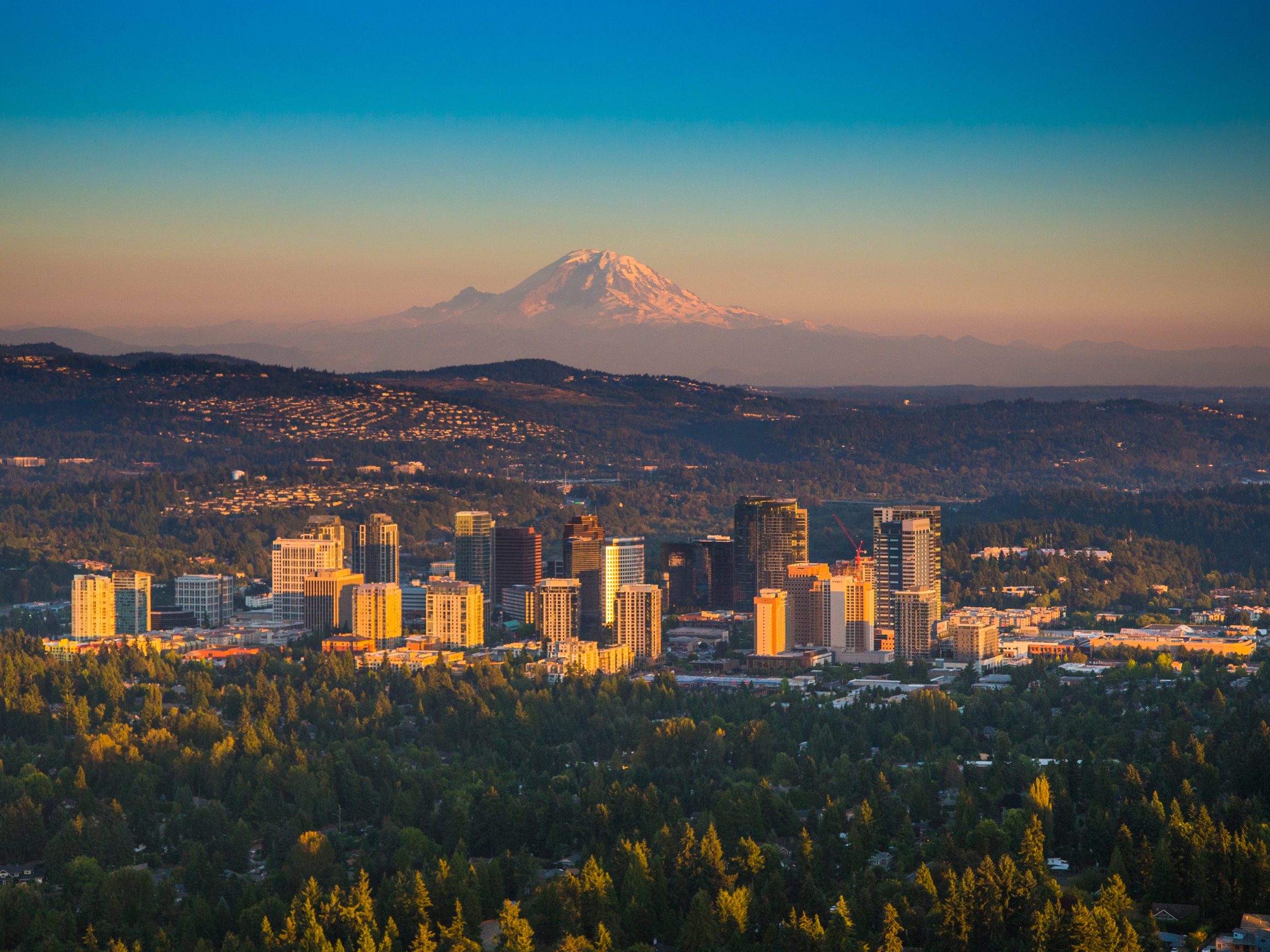
Bellevue is one city, but it contains several distinct housing markets. The City of Bellevue recognizes 16 broad neighborhood areas, with smaller communities and locally used names such as Enatai, Vuecrest, Newport Shores, Old Bellevue, and the Spring District.
For buyers, the neighborhood name is a starting point. Housing type, lot characteristics, views, road noise, school assignment, transit access, and future development can change within a few blocks.
How Bellevue Neighborhood Names Work
Bellevue neighborhood names can get confusing because the City’s official boundaries don’t always match the names you’ll see in real estate listings. The City recognizes 16 broad neighborhood areas, including Downtown, West Bellevue, Northwest Bellevue, Bridle Trails, Somerset, Newport, Lake Hills, Wilburton and BelRed. Many of those areas contain smaller communities with names buyers are more likely to encounter during a home search.
West Bellevue is a good example. The City defines it as generally south of Downtown, west of I-405 and north of I-90, with communities including Enatai, Bellecrest, Surrey Downs, Killarney Circle and Meydenbauer Point. Northwest Bellevue is officially a separate area and includes Meydenbauer Bay, Vuecrest, Apple Valley and Northtowne, among others.
In real estate, however, you may hear “West Bellevue” used more broadly for close-in neighborhoods west of I-405. When comparing homes, pay attention to the specific community and address rather than assuming two listings labeled West Bellevue are in the same part of the city.
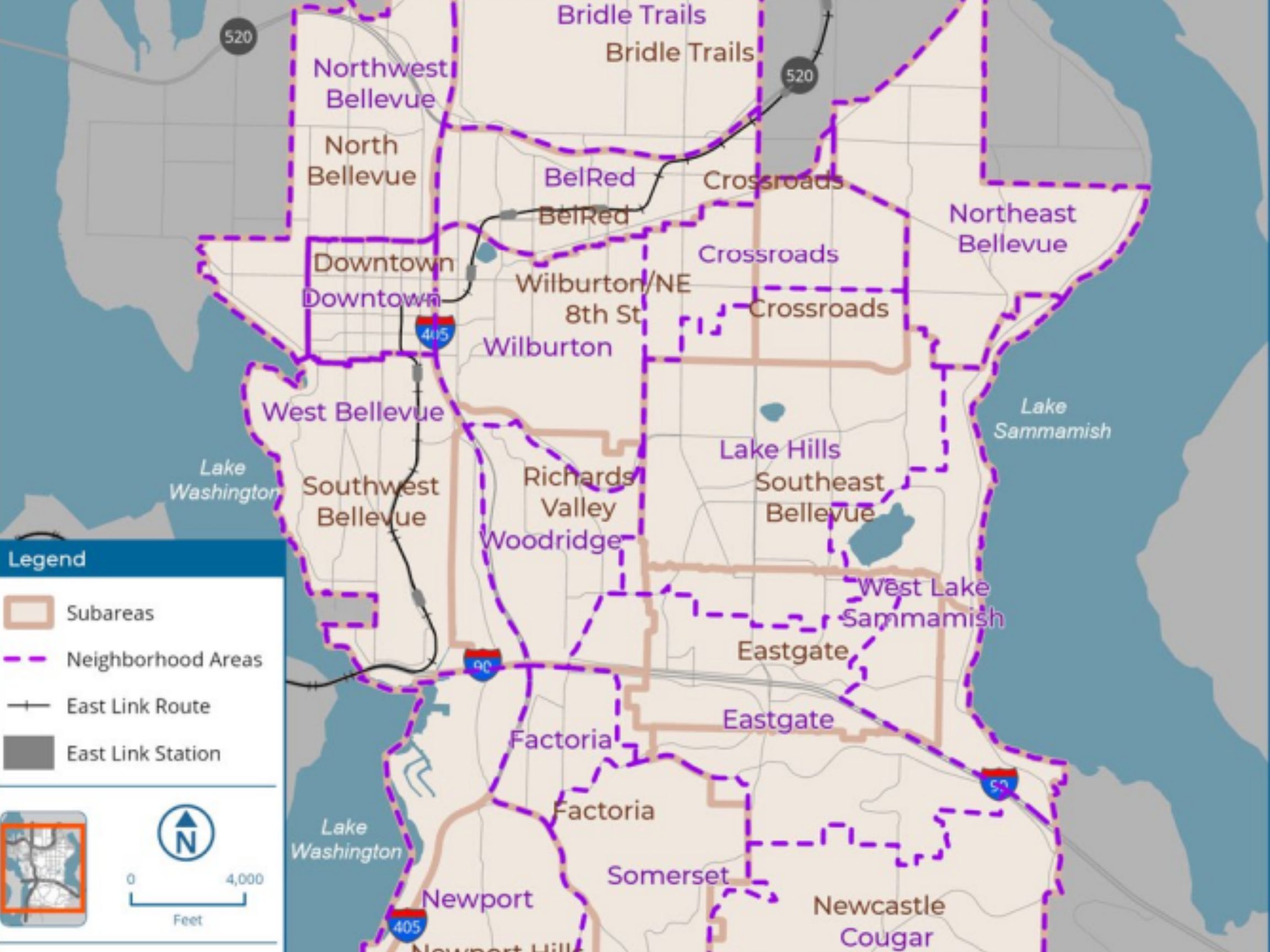
Bellevue’s official neighborhood areas and subareas. Source: City of Bellevue.
Downtown Bellevue and Old Bellevue
Downtown Bellevue has the city’s largest concentration of high-rise condominiums and apartments, with offices, restaurants, shopping, parks and transit all within a relatively compact area.
Where you buy within Downtown matters. A condo near Bellevue Downtown Station puts you close to light rail and the commercial core, while a home near Downtown Park, Main Street or Meydenbauer Bay offers a different mix of views, walking routes, traffic and surrounding development.
Bellevue Downtown Station is served by the 2 Line, which now connects Bellevue across Lake Washington through Mercer Island to Seattle. For condo buyers, it’s worth looking beyond the distance to the station and considering the route you’ll actually walk, along with nearby construction and planned development.
Old Bellevue
Old Bellevue generally refers to the Main Street area at the southern end of Downtown. It has a lower-scale commercial character than much of the high-rise core, with Downtown Park and Meydenbauer Bay nearby.
I wouldn’t treat Old Bellevue as a hard residential boundary. A listing may use the name because a property is within walking distance of Main Street even though it technically falls into another area.
Buying a Downtown Bellevue Condo
With Downtown Bellevue condos, I’d spend at least as much time evaluating the building as the neighborhood.
Review association reserves, insurance coverage, assessments and maintenance history. Understand parking and storage, pet and rental rules, elevator access and any major projects planned for the building. Then look outside: views, nearby parcels and proposed development can have a direct effect on the property you’re buying.
You can explore current inventory on the David Hogan Homes properties page.
BelRed and the Spring District
BelRed is one of Bellevue’s clearest examples of a neighborhood where the surroundings are still changing.
The corridor is transitioning from its historic industrial and commercial pattern toward a denser mix of housing, offices, retail, and transit-oriented development. The Spring District sits within this larger area, with both Spring District and BelRed stations providing 2 Line access.
For buyers, the surrounding blocks matter almost as much as the property itself. Nearby development, construction, parking, street connections, and the actual walking route to light rail are all worth understanding before you buy.
Wilburton
Wilburton sits immediately east of Downtown, between the urban core and established residential neighborhoods farther east. It contains single-family and multifamily housing, with Bellevue Botanical Garden and Kelsey Creek Park providing useful geographic anchors.
Wilburton Station also puts the area directly on the 2 Line. With residential streets close to areas seeing new housing, commercial development, and transportation investment, nearby projects and I-405 exposure are worth considering alongside the home itself.
West Bellevue
West Bellevue is often discussed as one of Bellevue’s luxury markets, but that description can hide how much variety exists here.
The City’s West Bellevue area includes Enatai, Bellecrest, Surrey Downs, Killarney Circle and Meydenbauer Point. It sits south of Downtown, west of I-405 and north of I-90, with Lake Washington and Mercer Slough forming important parts of its geography.
Housing ranges from older established homes and substantial remodels to new construction, view properties and Lake Washington waterfront.
Enatai and Meydenbauer Point
Enatai offers a residential setting close to I-90 and South Bellevue Station, while Meydenbauer Point is more closely oriented toward Lake Washington and Downtown. For waterfront properties, shoreline and dock characteristics become an important part of the comparison.
Bellecrest, Surrey Downs and Killarney Circle
These are separate residential pockets with different relationships to Downtown, Bellevue Way, I-405 and nearby commercial areas.
I’d compare street configuration, lot shape, housing stock, renovation history and traffic rather than grouping them together simply because they share the West Bellevue label.
South Bellevue Station
South Bellevue Station is relevant for homes around Enatai, Mercer Slough and portions of West Bellevue. The 2 Line now connects the station across Lake Washington as well as through Downtown Bellevue and toward Redmond.
Walk the route from a house you’re considering. Sidewalks, grade, crossings and traffic matter more than the straight-line distance shown on a map.
Northwest Bellevue
Northwest Bellevue wraps around the northern and western sides of Downtown and borders communities including Medina, Clyde Hill and Kirkland.
The City identifies Meydenbauer Bay, Vuecrest, Diamond S Ranch, Bellewood Farms, Apple Valley and Northtowne among its communities. Housing includes older neighborhoods and single-story homes alongside extensive remodels and larger replacement construction.
Meydenbauer Bay and Vuecrest
Meydenbauer Bay and Vuecrest are two of Northwest Bellevue’s closest residential pockets to Downtown, but their settings are quite different. Meydenbauer Bay is oriented toward Lake Washington and the waterfront, while Vuecrest sits on higher ground immediately northwest of Downtown, where some properties take advantage of the elevation and views.
Northtowne, Apple Valley and Other Residential Pockets
Northtowne, Apple Valley, and other residential pockets in Northwest Bellevue have a mix of original homes, substantial remodels, and newer construction on older lots. When comparing properties in these neighborhoods, it’s worth looking at both the home’s renovation history and what’s happening nearby, since replacement construction and redevelopment can vary from street to street. .
West Bellevue vs. Northwest Bellevue
West Bellevue and Northwest Bellevue are easy to confuse, especially because “West Bellevue” is sometimes used more broadly in real estate conversations. Officially, West Bellevue lies primarily south of Downtown, while Northwest Bellevue extends around the northern and western sides of Downtown. Each includes its own smaller neighborhoods and offers different access to Downtown, Lake Washington, and surrounding areas.
Bridle Trails
Bridle Trails is known for its wooded setting, equestrian history, trail access, and larger residential lots. Bridle Trails State Park anchors the area, which also includes communities such as Trails End, Pikes Peak, Cherry Crest, Bellemead, North Creek, and Compton Trails.
For buyers, lot size is only part of the picture. Trees, easements, drainage, and access can affect how much of a property is usable or developable. Bellevue’s tree regulations also require permits for removing significant or landmark trees in Bridle Trails, making the rules worth reviewing before planning renovations or new construction.
Housing and lot characteristics vary throughout Bridle Trails, so buyers shouldn’t assume every property is an estate or equestrian property.
Northeast Bellevue
Northeast Bellevue stretches toward Lake Sammamish and the Redmond border.
Local names include Sherwood Forest, Lakewood Park, Bretton Wood, Tam O’Shanter and Ardmore. Much of the western portion contains neighborhoods developed during the second half of the 20th century, while areas farther east include hillside and Lake Sammamish-oriented properties.
For buyers working in Redmond or around Microsoft, commute routes can be part of the appeal. Still, compare the individual house carefully: age, remodel history, road access and neighborhood-association amenities can differ substantially.
Crossroads
Crossroads is centered around Crossroads Shopping Center and Crossroads Park, with a mix of condos, townhomes, apartments, and established single-family neighborhoods nearby. It’s one of the more commercially active parts of Bellevue outside Downtown, with everyday shopping, dining, and recreation concentrated in a relatively small area.
Housing changes quickly as you move away from the main commercial corridors, so the residential experience can vary quite a bit within the neighborhood.
Lake Hills
Lake Hills is one of Bellevue’s larger residential areas and has a particularly varied housing mix.
The Lake Hills Greenbelt, Phantom Lake, Larsen Lake, Lake Hills Village and Robinswood Community Park help orient the area. You’ll find older single-family houses, remodeled homes, infill construction, townhomes and multifamily housing.
Properties near wetlands, streams or greenbelts deserve additional research. Bellevue regulates streams, wetlands, geological hazards, flood areas, shorelines and other environmentally sensitive areas, with buffers and setbacks that can affect how a site can be used.
Woodridge
Woodridge sits between Downtown Bellevue, Factoria, and I-90, with established residential streets and some properties overlooking Lake Washington, Seattle, or Downtown Bellevue.
Norwood Village is a smaller, architecturally distinct part of the area, with homes originally designed in response to the terrain and surrounding views.
Somerset
Somerset is an elevated South Bellevue neighborhood that includes communities such as Forest Hill, Eaglesmere, Westwood Highlands, Forest Park, and Forest Glen. Its hillside setting gives some homes views toward Lake Washington, Seattle, Bellevue, or the Olympic Mountains, though sightlines vary considerably by property. Buyers should pay close attention to slope, drainage, retaining walls, driveway grade, and any association obligations.
Newport, Newport Hills and Newport Shores
The City’s broader Newport area includes Newport Hills, Lake Heights, Greenwich Crest, Lake Lanes and Newport Shores.
Newport Hills and Lake Heights
These established residential areas offer convenient access to both I-90 and I-405, with housing that ranges from older homes to remodeled and newer properties.
Greenwich Crest
Greenwich Crest is known for its hillside setting and view-oriented homes, with established residential streets and convenient access to South Bellevue and I-90.
Newport Shores and Lake Lanes
Newport Shores was developed around man-made inlets, while Newport Shores and Lake Lanes both include homes designed around access to Lake Washington and boating. For waterfront buyers, the details of that access matter, including dock rights and permits, water depth, bulkhead condition, association responsibilities, and access to open water. Bridge clearance can also be a consideration for some properties. Canal or inlet frontage should be evaluated differently from direct Lake Washington frontage.
Factoria and Eastgate
Factoria and Eastgate are separate Bellevue neighborhood areas, although they’re commonly discussed together because both are close to the I-90/I-405 interchange.
Factoria has a substantial commercial center with multifamily and nearby single-family housing. Eastgate extends farther east and includes residential neighborhoods, Bellevue College and employment areas.
Easy access to I-90 and I-405 is a benefit of the area, but freeway sound and traffic can vary considerably by street. It’s worth driving the routes you’d use at different times of day to understand congestion and how the home’s location relative to major roads affects the setting.
Cougar Mountain and Lakemont
Cougar Mountain and Lakemont sit along Bellevue’s southeastern edge, with residential communities woven around wooded hillsides and trail networks. The area includes neighborhoods such as the Summit, Forest Ridge, and Vuemont, with many homes developed more recently than those in Bellevue’s older central neighborhoods.
The terrain and surrounding natural areas are an important part of evaluating property here, particularly when future additions or redevelopment are a consideration. Critical-area regulations may affect how much of a lot can be developed.
West Lake Sammamish
West Lake Sammamish includes waterfront and residential neighborhoods along Lake Sammamish and around Phantom Lake, with local areas such as Spiritridge, Sammamish Heights, Rosemont Beach, and Lake Manor.
Lake Sammamish waterfront has its own set of considerations compared with Lake Washington. Shoreline orientation, sun exposure, water depth, dock conditions, and access to the lake can vary considerably. Some homes sit directly along the shoreline, while others are positioned above the lake or farther inland, creating a mix of waterfront, view, and interior properties.
Bellevue’s shoreline regulations apply to both Lake Sammamish and Lake Washington, so shoreline conditions, existing improvements, and permitting history should be part of the review for waterfront properties.
Choosing a Bellevue Neighborhood Based on Your Priorities
For Downtown access and light rail, consider Downtown, Wilburton, BelRed, the Spring District, and areas near South Bellevue Station.
For close-in detached homes, West Bellevue, Northwest Bellevue, Wilburton, and Woodridge offer different versions of proximity to Downtown.
For larger lots and wooded settings, Bridle Trails is a natural starting point, along with selected properties around Cougar Mountain and Lakemont.
For views, look at individual properties in Somerset, Woodridge, Greenwich Crest, Cougar Mountain/Lakemont, and portions of West and Northwest Bellevue.
For waterfront, distinguish between Lake Washington, Lake Sammamish, and Newport Shores-style inlet properties. The type of waterfront matters as much as the neighborhood.
For newer urban housing, Downtown, BelRed, and the Spring District offer the greatest concentration.
Bellevue Schools: Verify the Address
One detail that catches buyers off guard is that Bellevue city limits and school-district boundaries aren’t identical.
Don’t assume the neighborhood name or nearest school determines the assignment. Verify the district and current elementary, middle and high school attendance areas using the relevant district’s official address tools before relying on the information in a listing.
I also recommend checking for planned boundary changes and transportation eligibility when those are important to your decision.
Property Details That Can Matter More Than the Neighborhood in Bellevue
Neighborhood reputation provides useful context, but two homes a few blocks apart can still be very different.
Construction: Review permit and renovation history, major systems, and construction quality. For condos, include association finances and building maintenance.
Land: Critical areas, trees, drainage, shorelines, and other site conditions can affect how a property can be used or expanded.
Surroundings: Consider road exposure, nearby development, views, transit access, and how neighboring properties may change over time.
Waterfront: Review shoreline conditions, docks, bulkheads, water depth, access, and permitting history.
How Location Affects Bellevue Home Value
A citywide median price provides context for the Bellevue housing market, but it says relatively little about an individual property. A Downtown condo, Bridle Trails home, Somerset view property, and Newport Shores waterfront home compete in very different segments.
For valuation, I narrow the competitive set as much as the available sales allow. Property type and location come first, followed by lot characteristics, views or waterfront, condition and construction quality, association health where applicable, road exposure, and recent comparable sales.
Frequently Asked Questions About Bellevue Neighborhoods
What are the main neighborhoods in Bellevue?
Bellevue has 16 broad neighborhood areas recognized by the City for planning purposes. They include Downtown, West Bellevue, Northwest Bellevue, Bridle Trails, Somerset, Newport, Lake Hills, Woodridge, Crossroads, and other areas across the city. Many contain smaller communities with their own locally used neighborhood names.
What is considered West Bellevue?
West Bellevue is generally south of Downtown Bellevue, west of I-405, and north of I-90. It includes communities such as Enatai, Bellecrest, Surrey Downs, Killarney Circle, and Meydenbauer Point. In real estate conversations, “West Bellevue” is sometimes used more broadly.
What is the difference between West Bellevue and Northwest Bellevue?
West Bellevue is primarily south of Downtown, while Northwest Bellevue extends around the northern and western sides of Downtown. Northwest Bellevue includes communities such as Meydenbauer Bay, Vuecrest, Apple Valley, and Northtowne.
What are the best neighborhoods in Bellevue, WA?
The best Bellevue neighborhood depends on the home, setting, and location you prefer. Downtown offers condos and walkability; West and Northwest Bellevue offer close-in residential neighborhoods; Bridle Trails is known for wooded settings and larger lots; Somerset has hillside and view homes; and Newport Shores is centered around waterfront living and boating.
Which Bellevue neighborhoods are closest to light rail?
Bellevue neighborhoods with convenient access to 2 Line light rail include Downtown, Wilburton, BelRed, the Spring District, and areas near South Bellevue and East Main stations. Walking access varies by address, so it’s worth checking the route from a specific property to the nearest station.
Which Bellevue neighborhoods have larger lots?
Bridle Trails is one of the first Bellevue neighborhoods to consider for larger residential lots. Some properties in Cougar Mountain/Lakemont and other less densely developed areas also offer more land, although lot size and usability vary by property.
Which Bellevue neighborhoods have views?
Bellevue neighborhoods with view homes include Somerset, Woodridge, Greenwich Crest, Cougar Mountain/Lakemont, and portions of West and Northwest Bellevue. Depending on the property, views may include Lake Washington, Lake Sammamish, Seattle, Downtown Bellevue, and the Olympic or Cascade mountains.
Which Bellevue neighborhoods have waterfront homes?
Bellevue waterfront homes can be found along Lake Washington and Lake Sammamish. Newport Shores also has homes along man-made inlets with boating access, while other waterfront properties are found in West Bellevue, Northwest Bellevue, Newport, and West Lake Sammamish.
Which Bellevue neighborhoods have luxury condos?
Downtown Bellevue has the city’s largest concentration of luxury condominiums. Buildings vary considerably in location, views, floor plans, construction, parking, amenities, association finances, and maintenance history.
How do I verify the assigned schools for a Bellevue home?
Verify school assignments using the official address lookup for the school district serving the property. A Bellevue address doesn’t necessarily indicate a particular school assignment, so buyers should confirm schools using the specific property address.
Bellevue offers a wide range of homes and neighborhoods, and finding the right fit often comes down to the details of the location and property. If you’re comparing Bellevue neighborhoods or have a specific home in mind, reach out. I’d be happy to help you narrow the search and talk through your options.